

PG Stock Options: When the Math Says “Wait”… and When It Doesn’t

February 5, 2026

One of the most common questions we get from PG clients sounds like this:

“Should I keep holding my stock options, or does it make sense to start taking chips off the table?”

The unsatisfying answer is: it depends. The helpful answer is: the math gives us some very clear guideposts.


Over the past several weeks, we’ve been running updated modeling on PG stock options across many client situations. While individual share counts and elections differ, PG’s equity programs share a common structure — same grant years, same strike prices, same 10-year option lives.


That consistency allows us to step back and share a normalized framework for thinking about PG stock options — one that applies broadly, and then gets customized for taxes, concentration, and goals.


Where PG stock options come from

PG equity exposure generally comes from two programs:

STAR Awards

STAR awards allow participants to choose cash or stock. In most cases, we recommend taking STAR in cash.


  • Reduces concentration in PG stock
  • Improves flexibility for taxes and diversification
  • Avoids layering unnecessary equity risk


That said, when STAR is taken as stock (or converted into options), it fits cleanly into the same option framework below.

LTIP (Long-Term Incentive Plans

LTIPs typically allow participants to choose between RSUs or stock options. This is where option modeling matters most, because options introduce leverage, time value, and expiration risk.

Simple framing: STAR is usually a cash decision. LTIPs are a long-term risk decision.

Simple framing: STAR is usually a cash decision. LTIPs are a long-term risk decision.Simple framing: STAR is usually a cash decision. LTIPs are a long-term risk decision.


The question we actually care about

We’re not trying to predict where PG stock goes next.


Instead, the core planning question is:


  • "Are you still being paid to wait?"


To answer that, we use a Black-Scholes option pricing model, adjusted for PG’s dividend.

Key assumptions (for illustration)

  • PG stock price: $160
  • Volatility: 3-year historical volatility
  • Dividend yield: Current PG dividend
  • Risk-free rate: Current Treasury yields
  • Option life: 10 years from grant
  • As-of date: February 4, 2026


This is planning math — not trading math.


PG stock options — normalized view (per option)

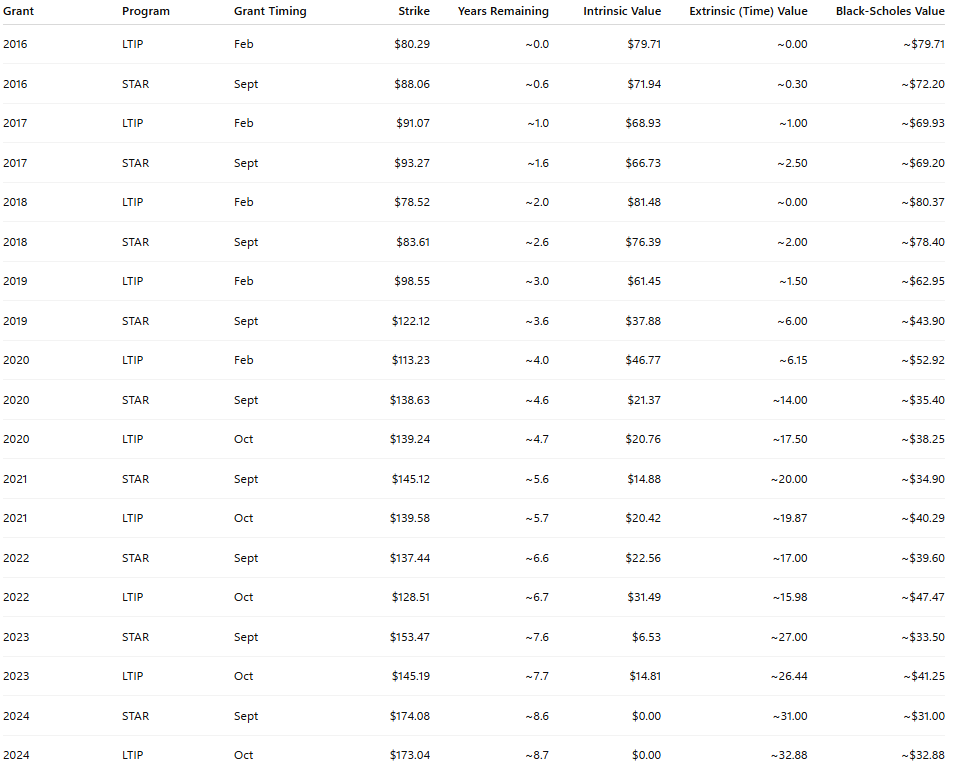
Below is a share-count-free view of PG option behavior across grant years. All values are shown per option, which allows the framework to apply regardless of how many options you personally hold.

Normalized PG Option Values (STAR + LTIP)

Table showing normalized P&G stock option values from 2016-2024, comparing intrinsic and extrinsic time value using Black-Scholes modeling

How to read this table:


  • Intrinsic value: What the option is worth if exercised today
  • Extrinsic (time) value: What you’re being paid to wait
  • Black-Scholes value: Intrinsic + time value

The pattern than matters

Older grants (roughly 2016-2018)

  • Very little time remaining
  • Nearly all value is intrinsic
  • Dividend drag overwhelms optional upside


Translation: These behave much more like stock than options. You’re no longer being paid to wait — but you’re still taking downside risk.

Mid-Life grants (roughly 2019-2020)

  • Some remaining time value
  • Upside still matters, but patience has a cost


Translation: These often call for a hybrid approach — partial monetization while keeping some upside exposure.

Newer grants (2021-2024)

  • A meaningful portion of value is still time value
  • These benefit from patience and volatility


Translation: Generally, no urgency unless driven by taxes, liquidity needs, or concentration risk.


A quick note on dividends

Dividend timing feels important, but economically:


  • Stock prices adjust automatically
  • Option values already reflect ongoing dividend drag
  • The existence of dividends matters — not the dates


Dividend timing doesn’t change the conclusions above.


The big picture

This analysis isn’t about calling tops or bottoms. It’s about aligning decisions with math, risk, and behavior.


A simple framework we use:


  • Older grants: Manage like stock
  • Mid-life grants: Be selective and intentional
  • Newer grants: Let optionality work


We’ll continue refreshing this analysis as prices, volatility, and time change — and then tailor execution to each client’s personal situation.


If you’d like to review how this applies specifically to your PG stock options, we’re always happy to walk through it together.

Recent Insights

August 28, 2026
In this webinar for P&G employees & retirees, Keith Hamberg, CFP® is joined by Hunter Cloud, CFP®, CPA and ARAG estate planning attorney, Andrew Larkin.
Guide on choosing between P&G stock options and RSUs for long-term incentive awards
August 3, 2026
Should you choose stock options or RSUs for your P&G LTIP award? Discover a strategic decision framework to align your equity compensation with your wealth goals.
Black title slide reading “Beyond the Bounty” on dark green, with P&G and Beyond Wealth Partnership logos.
July 15, 2026
Explore key questions every Procter & Gamble employee should ask on PST Contribution Day to optimize their retirement portfolio and asset allocation.