

Unlocking Hidden Tax Savings: The P&G Employee Guide to IRA Basis Conversions

December 11, 2025

Most P&G employees know the value of maximizing their Savings Plan and PST contributions. But one area often overlooked—and potentially worth tens or even hundreds of thousands of dollars—is basis inside a Traditional IRA.


This article explains:


  • What IRA basis is
  • How to determine whether you have it
  • Why it is so valuable
  • And how P&G employees uniquely benefit from having access to a 401(k) plan that allows roll-ins, making a strategy known as the "Roth basis conversion" far easier than it is for most people.

What is IRA basis?

When you contribute to a Traditional IRA, you generally receive a tax deduction…unless you’re covered by a workplace retirement plan (like the P&G Savings Plan) and your income exceeds IRS limits.


If you weren’t eligible for a deduction in a prior year, you may have made non-deductible IRAA contributions. These after-tax contributions are called your IRA basis.

Why this matters

Your basis:


  • Is not taxed again when withdrawn
  • Does grow, and that growth is taxed as ordinary income unless you act on it
  • Is tracked on Form 8606 of your tax return


Many P&G employees have small amounts of basis scattered across years—$5,000 here, $6,000 there—especially if income was too high for IRA deductibility.


How to find your basis on the tax return

To determine your basis, pull your most recent tax return and look at:

Form 8606—Nondeductible IRAs

Key lines:


  • Line 1: Non-deductible contribution made for that tax year
  • Line 2: Total basis carried forward from prior years
  • Line 14: Cumulative basis going into the next tax year


If you see a value on Line 14, you have basis.

Tip for P&G employees: Many tax software systems automatically populate Form 8606 only when nondeductible contributions are identified. If you’ve changed CPAs or used different software over the years, basis reporting can become inconsistent — this is why gathering past returns is so valuable.


Why converting IRA Basis to a Roth is so valuable

Here’s the key insight:

Your IRA basis can be converted to a Roth IRA tax-free — but the IRS pro-rata rule normally prevents you from converting just the basis.

Example

Let’s say you have:


  • $50,000 IRA basis (after-tax money)
  • $450,000 of pre-tax IRA assets


If you convert $50,000 to Roth, the IRS treats your conversion as 10% basis, 90% taxable, meaning you would owe tax on $45,000 of the conversion. Not ideal.

The Goal

We want:


  • 100% of the basis converted
  • 0% of the pre-tax IRA converted


To do this, we need to temporarily move the pre-tax IRA dollars out of the IRA.$450,000 of pre-tax IRA assets.


The Strategy: How P&G employees can convert basis tax-free

Because the P&G Savings Plan accepts roll-ins, you have a key advantage that many employees at other companies do not have.


You can remove the pre-taxportion of your Traditional IRA by rolling it into:


Option A: A Solo 401(k)


-or-


Option B: The P&G 401(k)/Savings Plan


The step-by-step process

Step 1 — Identify your IRA basis

Using Form 8606 as described above.

Step 2 — Roll all pre-tax IRA dollars into the P&G 401(k)

When this is done correctly, your Traditional IRA will be left holding only the basis—the after-tax money.

Step 3 — Convert the remaining basis to a Roth IRA

With no pre-tax dollars contaminating the IRA, the pro-rata rule does not apply.


Your conversion is 100% tax-free.

Step 4 — Enjoy tax-free compounding

Every dollar of future growth inside the Roth is:


  • Tax-free
  • RMD-free
  • Significantly more efficient for legacy planning


For example, if $50,000 grows to $300,000 over time, all $250,000 of growth is tax-free.


Why this matters to P&G employees

Many large corporate 401(k) plans do not accept IRA roll-ins, which forces clients to create a Solo 401(k) just to execute this strategy.


P&G employees, however, can leverage the Savings Plan instead—making this:


  • Easier
  • Cleaner
  • Often faster
  • With no need to create a business or administer a Solo 401(k)


This is one of the most overlooked planning opportunities available to long-time P&G employees.


When should you consider this strategy?

You may be a good candidate if:


  • You have any basis on Form 8606
  • You have Traditional IRA balances that include both pre-tax and after-tax money
  • You wish to maximize tax-free growth
  • You want to reduce future RMDs
  • You want cleaner, more tax-efficient legacy outcomes for your children


Even if the basis is small—$5,000, $10,000, $25,000—this strategy can still create significant long-term tax savings.


Final thoughts & next steps

Converting IRA basis to Roth the right way is one of the most powerful yet underutilized tax strategies available to P&G employees. The benefits compound dramatically over time and extend far beyond just tax savings—they improve flexibility, retirement security, and generational planning.


If you’re unsure how much basis you have or want help estimating the potential value of a tax-free conversion, feel welcome to schedule a consultation.

Recent Insights

August 28, 2026
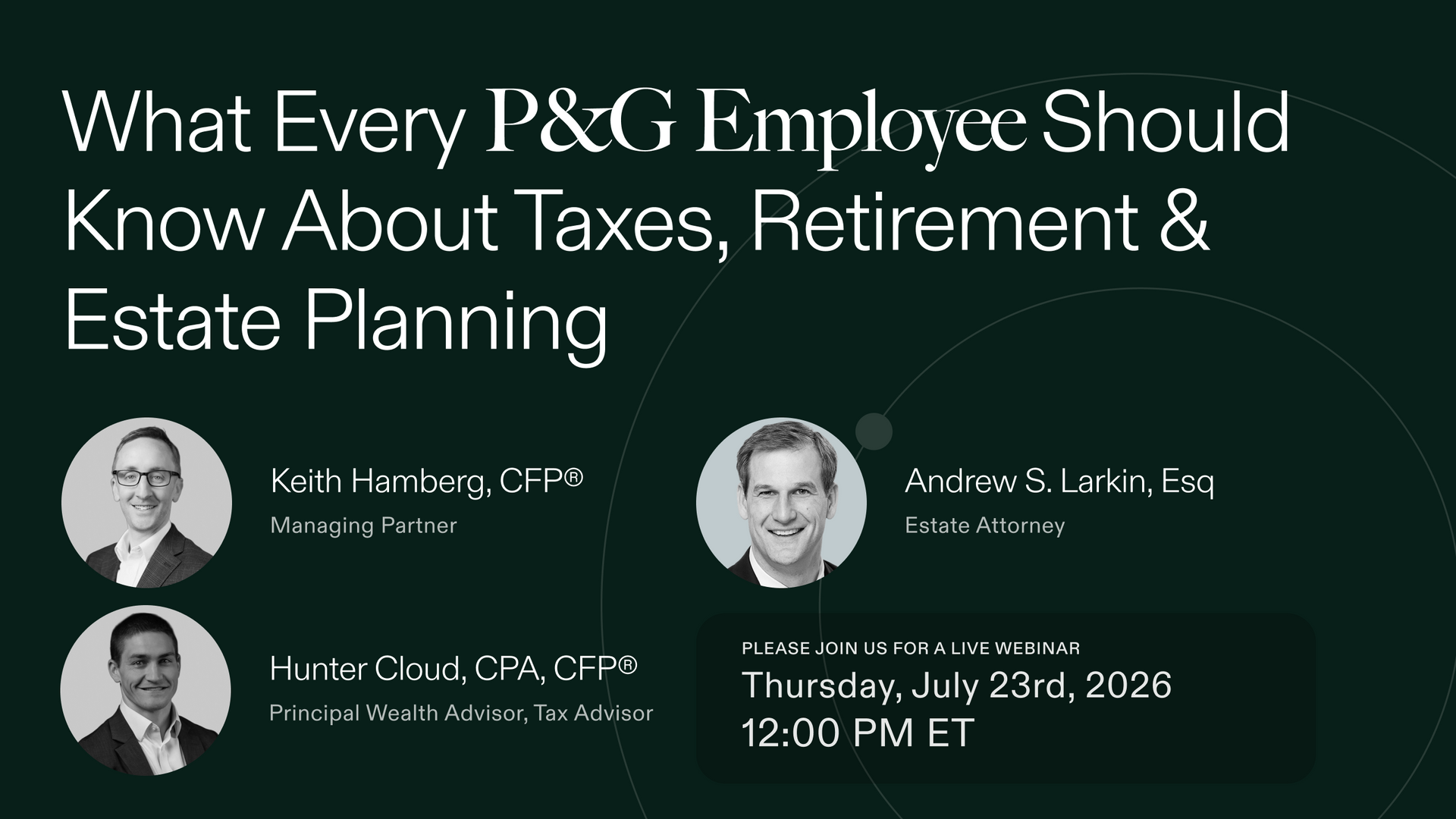
In this webinar for P&G employees & retirees, Keith Hamberg, CFP® is joined by Hunter Cloud, CFP®, CPA and ARAG estate planning attorney, Andrew Larkin.

Guide on choosing between P&G stock options and RSUs for long-term incentive awards
August 3, 2026
Should you choose stock options or RSUs for your P&G LTIP award? Discover a strategic decision framework to align your equity compensation with your wealth goals.

Black title slide reading “Beyond the Bounty” on dark green, with P&G and Beyond Wealth Partnership logos.
July 15, 2026
Explore key questions every Procter & Gamble employee should ask on PST Contribution Day to optimize their retirement portfolio and asset allocation.