Including Current Valuations of Every Outstanding P&G Stock Option Grant
A practical guide for current and former Procter & Gamble employees to help you evaluate the value of your stock options and make more informed decisions.
Current valuation
Black-Scholes* value for every outstanding grant.
Time Value Insights
Understand how much optionality remains.
Planning Considerations
Key factors before making exercise decisions.
Tax Planning Ideas
How options fit into your broader financial plan.
Why this guide exists
Stock options can be one of the most valuable components of your total compensation. They can also be one of the most misunderstood.
A common approach is to look only at the difference between today's stock price and your exercise price. While this shows the intrinsic value, it does not capture the full economic value of the option.
Every option has time value — the value of keeping the option alive rather than exercising it today. The Black-Scholes model is one of the most widely used methods for estimating this value.
The goal of this guide
- The current value of every outstanding P&G stock option grant
- Where meaningful time value remains
- The key considerations before making exercise decisions
- How options fir into your overall financial plan
*This guide provides general information only and is not financial, tax, or legal advice.
Understanding Your Option Value
The value of a stock option has two components.
Intrinsic Value — what you'd receive today if you exercise
+ Time Value — what your option is woth because you can wait
= Total Value
Intrinsic value is easy to see — it's simply the difference between the current stock price and your strike price (if the option is in the money).
Time value is harder to see, but potentially very valuable. It reflects:
- Time until expiration
- Expected volatility of the stock
- Risk-free interest rates
- Dividend yield
As expiration approaches, time value declines. Once an option is exercised, all remaining time value is gone forever.
Key Takeaway
Exercising too early can result in giving up meaningful value.
P&G Stock Option Dashboard
Analysis as of May 27, 2025 | PG Stock Price: $147.00
Current valuations for every outstanding grant, using the Black-Scholes model
P&G Stock option dashboard
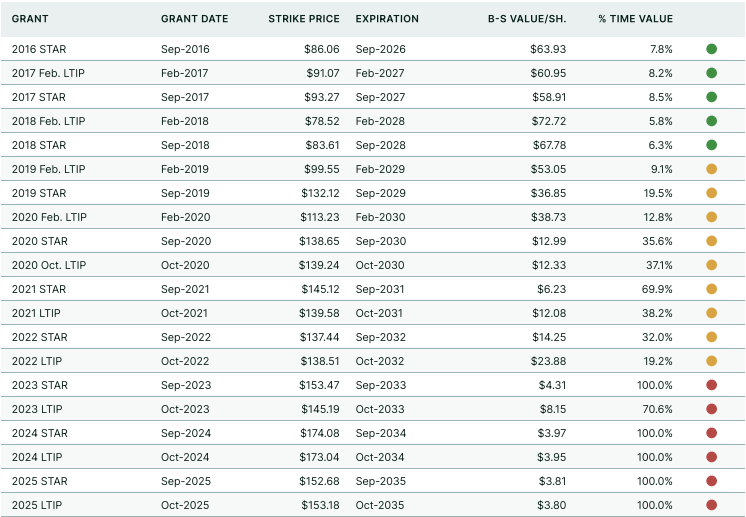
This analysis uses the Black-Scholes model with assumptions detailed in the disclosures. Values will change as the market conditions change.
Grant-by-grant commentary
The traffic lights on the dashboard help you quickly see where time value remains. Here's what each category generally means:
Green — limited time value (2016-2018 grants)
Most of the value remaining is intrinsic. These grants are either near expiration or have lower volatility and less time remaining.
May be worth reviewing for exercise, especially if you have:
- Diversification needs
- Concentrated positions
- Upcoming liquidity needs
- Favorable tax planning opportunities
Yellow— moderate time value (2019-2022 grants)
These grants still have meaningful optionality. Time value is higher because there is more time until expiration.
Exercise decisions should consider:
- Your tax picture
- Cash needs
- Retirement timing
- How these grants fit with other income events
Red— high time value (2023-2025 grants)
Substantial optionality remains. These are longer-dated grants with the highest percentage of time value.
Exercising early may give up significant value unless you have a compelling reason, such as:
- Large diversification needs
- Cash needs
- Company stock concentration
- Upcoming financial obligations
- Tax planning opportunities
Four biggest mistakes we see
Avoiding these mistakes can protect — and potentially increase — the value of your options.
01
Exercising simply because the option is "in the money."
Intrinsic value is only part of the story — you may be giving up meaningful time value.
02
Waiting until the last minute.
You reduce flexibility and increase risk when you wait until just before expiration.
03
Ignoring the tax impact.
The tax consequences of an exercise can be substantial and should be planned for, no discovered after the fact.
04
Evaluating each grant separately instead of as one portfolio.
Your exercise strategy should align with your total financial plan, not just one grant.
Tax considerations
Taxes ore often the most significant consideration in a stock option exercise. Upon exercise of a non-qualified option (NSO), you recognize ordinary income equal to the spread between market price and strike price.
Tax planning before an exercise can make a meaningful difference in your after-tax outcome.
Federal Ordinary income
Taxed at your marginal rate. P&G typically withholds 22% (the supplemental rate) upon exercise.
State income tax
Varies by state of residence.
Payroll taxes (FICA)
Social Security (6.2%) up to the wage base, plus Medicare (1.45%) and Additional Medicare (0.9%) for higher incomes.
Net Investment Income tax
A 3.8% additional tax may apply to investment income for higher-income taxpayers.
Capital Gains
The difference between sale price and exercise (cost) basis is taxed as long- or short-term capital gain.
Estimated taxes
Large exercises may require estimated payments to avoid underpayment penalties.
How options fit into retirement
Stock options interact with many areas of your financial life. A coordinated approach can help you make smarter decisions.

The right exercise strategy considers your entire plan, not just the options.
Value lost by exercising early
Time value is valuable — once you exercise, it is gone forever. The table below shows the potential you could give up by exercising today instead of waiting.
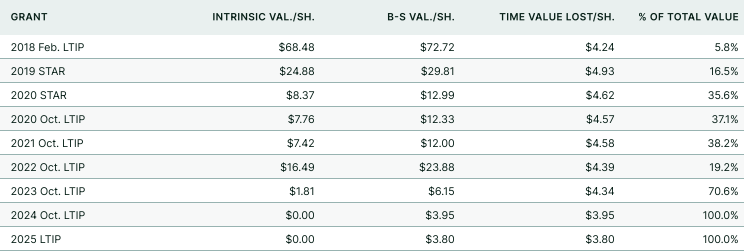
These amounts represent potential value that could be forfeited by exercising today instead of holding the option.
Frequently asked questions
Should I exercise my options immediately?
Not necessarily. It depends on time value, taxes, diversification needs, and your overall plan.
What if I retire or leave P&G?
You can generally continue to hold options until expiration, but you may also lose certain benefits like company tax withholding. Plan ahead.
Can I donate stock to charity instead of exercising?
You generally must exercise first, then donate the shares. Planning can help maximize the tax benefit.
What happens if the P&G stock price drops?
If you haven't exercised, your option may still have time value. Holding provides the flexibility to benefit from a future recovery.
How do I decide which grants to exercise?
Consider time value, taxes, diversifcation, cash needs and your overall financila plan.
This guide is intended for educational purposes only and does not constitute investment, legal, or financial advice. Stock options involve a high degree of risk and are subject to market volatility. The Black-Scholes model is one of many methods used to estimate option value and relies on assumptions that may not reflect future results.
Beyond Wealth Partners is an investment advisory firm registered with the SEC. Advisory services are only offered to clients and prospective clients where Beyond Wealth Partners and its representatives are properly licensed or exempt from licensure. The financial professionals with Beyond Wealth Partners are investment adviser representatives with Savvy Advisors, Inc. ("Savvy Advisors"), an investment adviser registered with the SEC. Beyond Wealth Partners is a marketing name only and is not separately registered — see www.SavvyWealth.com for our Form ADV and Form CRS.
Beyond Wealth Partners describes its services as "fee-only" because it receives compensation solely from client-paid advisory fees; Savvy Advisors and its affiliates may receive additional compensation related to certain investment solutions. Tax services are provided in a planning capacity—consult your own tax professional for specific filings.
Beyond Wealth Partners is an independent firm and is not affiliated with, endorsed by, or sponsored by Procter & Gamble. All investing includes risk, including the possible loss of principal.
Additional Guides